



 |
| —— Can you tell me how you got involved with kendo? My kendo training started in May of 1921, the day I was born. My father, Hiroji Miyahara trained me. He, like so many others, had come to the U.S. from Japan in 1918 to make money and to seek a better life here. At that time it wasn’t uncommon for Japanese immigrants to decide to stay here rather than go back to Japan, especially after starting families and establishing their lives here. My father was one of them and he decided to stay in the U.S. and teach kendo. He had achieved the rank of Sho-dan, which was pretty good at the time, and so he began teaching kendo in Southern California. Kendo was introduced and started being taught in the U.S. in the early 1900’s as a result of the wave of Issei (first generation Japanese immigrants in the U.S.) immigration. Most of them being born in the later part of the Meiji Era, were taught kendo in grade school and middle school. Naturally when they arrived here they continued practicing and even held kendo tournaments for recreation.
—— As a child, did you enjoy studying kendo?  No, I hated it! My father taught at six different kendo dojos, in Pomona, Baldwin Park, El Monte, San Bernardino, Riverside, and Coachella, and so I had no choice in the matter. He was the boss of the house and his word was final, so I went and practiced at every one of the six dojos five or six times a week. If you were a kid and had to go to kendo practice almost everyday, you wouldn’t like it either. Back then, Japanese kids usually studied either kendo or judo… and my father disliked judo. In judo, there is a lot of throwing and for young kids it’s okay, because their bones are kind of soft, but when you get to be 40 all the injuries surface. That’s why my father didn’t allow me to take judo. However, I did study judo for a couple of years when I was 16, because in the old days of kendo if you dropped your Shinai, you had to wrestle or do judo. I remember that I always got headaches or had a sore back after judo practice, so I quit it as soon as I could. No, I hated it! My father taught at six different kendo dojos, in Pomona, Baldwin Park, El Monte, San Bernardino, Riverside, and Coachella, and so I had no choice in the matter. He was the boss of the house and his word was final, so I went and practiced at every one of the six dojos five or six times a week. If you were a kid and had to go to kendo practice almost everyday, you wouldn’t like it either. Back then, Japanese kids usually studied either kendo or judo… and my father disliked judo. In judo, there is a lot of throwing and for young kids it’s okay, because their bones are kind of soft, but when you get to be 40 all the injuries surface. That’s why my father didn’t allow me to take judo. However, I did study judo for a couple of years when I was 16, because in the old days of kendo if you dropped your Shinai, you had to wrestle or do judo. I remember that I always got headaches or had a sore back after judo practice, so I quit it as soon as I could.
—— Did you study under anyone besides your father? You have to remember that we had Torao Mori Sensei here as well. He first came to the U.S. in 1938 and stayed for about two or three years and again in 1950. I learned a lot from Mori Sensei. When he first came to the U.S. my father picked him up and drove him to each of the six dojos. We went from one dojo to the next and for hours all they talked about was kendo. “Do this. This is the way you do kendo.” they would say, and I had no choice but to listen to them. That’s one of the ways I learned. Mori Sensei taught me, “Do Suriashi. Don’t stomp your feet.” He told me that he used to throw soy beans all over the floor when he practiced and said that if you do Suriashi, you will chase the beans with your feet, but if you don’t, you’ll get hurt. I never tried that, but I thought it was an interesting idea and made sense. Everybody told me that his footwork was terrific, and my father always reminded me to watch Mori Sensei’s footwork, but I couldn’t see his feet. One day, I asked Mori Sensei “Why do you wear your Hakama so long?” and he answered with a slight smile, “That is my secret!” with no further explanation. A number of years later, another Sensei came here and said, “Watch Mori Sensei’s feet” and I said, “I can’t see them. I can’t catch them.” Finally, that Sensei explained that if your body is facing a certain way, your feet will move a certain way as well. No matter what you do, your toes should be facing toward your opponent. That’s what you need to catch. “Oh, now I understand!”

Pomona Dojo winners of the Miyahara Kendo Tournament in 1936 (Mr. Miyahara is pictured 2nd row, center)
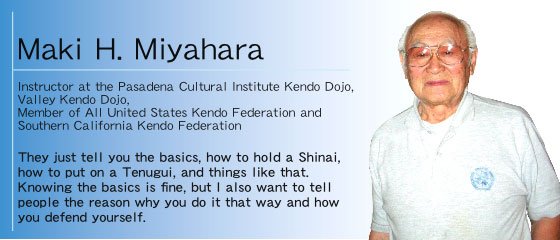
—— Was there ever a time in your life that didn’t practice kendo? The U.S. needed interpreters badly in Japan. I had two weeks of basic training at the Japanese school, where four military companies consisting entirely of Nisei soldiers were also trained. After they tested our Japanese skills they divided us into three groups. One group took a three-month class, the other group took a six-month class, and the last group took a nine-month class. I was placed in the six-month class and after I spent four months there, the student office told me that I had to reenlist for six more months if I wanted to go overseas. I really didn’t want to extend, but I agreed so I could go overseas. Six months later they asked me, “Why don’t you extend for one more year, and they’ll send you to officer’s candidate school?” I didn’t need that. I didn’t want to be an officer. I just wanted to get in and out, so I declined. Later I found out that hundreds of others were in the same situation. Finally after accepting a year of overseas duty I was sent to Japan and landed at Yokosuka on December 7, 1948, the day that Japan bombed Pearl Harbor. I also met my wife and got married in Zama, but they wouldn’t let me bring her back to the States, so I decided to stay in Japan with my wife. I was discharged from Zama in 1949 and fortunately got a job with the military government office in Ishikawa as a Welfare Officer and worked there until I returned to the U.S. 1954. I have a student whom I have been teaching for about 20 years. One year he went to St. Stevens by himself to attend a three-day seminar, and naturally he didn’t know anybody there. The first day, nobody paid much attention to him, but on the second day, someone asked where and with whom he studied, and he replied, “Miyahara-Sensei.” From that moment on, everyone welcomed him warmly. —— Can you tell us some of your goals for the future? Theoretically, you’re attacking 50% of the time and your opponent is attacking you 50% of the time. If you don’t know how to attack and how to defend yourself, you’ll lose. All Senseis who come around never teach defense, so I thought I should teach it. Whatever kind of sport you participate in you have to understand what you’re doing and why. You have to mentally rehearse it and practice it over and over until you get it. It seems every time I write one part of my book I get some new ideas and so I have to go back and edit it again and again. I don’t know when I’ll ever be able to finish it, but I’m looking forward to seeing it at the bookstores someday.
|


