



 |
| —— How did you first get interested in sumo? Well it all started while I was living in Japan. I was living in Ichikawa and spent a lot of tie on the trains commuting to work. I wasn’t very outgoing and didn’t really didn’t do too much, but toward the end of my stay in Japan, I started thinking about doing something to remember my time there̶ something Japanese. So I picked up a copy of the “Tokyo Journal” and began looking for different things to do around Tokyo. I tried a few of the day-hikes and then I saw the ad for sumo. Ryogoku wasn’t too far, so I decided to go. The stated time was from 9-6PM, so without knowing any better, I showed up at 9AM, bought my ticket and went in. No one really shows up for the early matches so from around 9:30 to 3 there I was, sitting all by myself, far from the ring in my designated seat, even though there couldn’t have been more that a couple dozen people there. I sat there for hours, watching the same things over and over again… all by myself, wondering what am I doing here. Finally, in the last hour or two, people started showing up and the major matches took place. That was my very first sumo experience… my introduction. I had studied other forms of martial arts and had an interest in Japanese culture, but before that day I never really had any particular interest in sumo. I remember thinking I’ll bet I could do that… little did I know what the future had in store!
—— Are there many differences between the sumo here and Japanese sumo?  Well first of all the CSA is amateur sumo, not professional, so we follow the standards of the International Sumo Federation, so it’s a little different than the Nihon Sumo Kyokai. For amateur sumo to become an Olympic sport there had to be international standards and so they established weight classes: light, middle and heavyweight, for both men and women, which is different than Japanese Professional sumo. Rules and clothing requirements are also slightly different, for example you are allowed to wear tights under your “mawashi” if you choose to and there is no slapping to the face. Basically the rules are the same however there is a condensed ritual, though not completely eliminated. Outside the dohyo there is the bow, which is standard, we don’t do the “shiko”, we step in the ring and come forward into position and squat in front of the other wrestler, the referee will then give the command “mattanashi”, no more waiting, then the wrestlers will get into final position with both hands on the floor out in front and the referee will give the command “hakioi” which starts the match, which is only slightly different than Japanese matches. Well first of all the CSA is amateur sumo, not professional, so we follow the standards of the International Sumo Federation, so it’s a little different than the Nihon Sumo Kyokai. For amateur sumo to become an Olympic sport there had to be international standards and so they established weight classes: light, middle and heavyweight, for both men and women, which is different than Japanese Professional sumo. Rules and clothing requirements are also slightly different, for example you are allowed to wear tights under your “mawashi” if you choose to and there is no slapping to the face. Basically the rules are the same however there is a condensed ritual, though not completely eliminated. Outside the dohyo there is the bow, which is standard, we don’t do the “shiko”, we step in the ring and come forward into position and squat in front of the other wrestler, the referee will then give the command “mattanashi”, no more waiting, then the wrestlers will get into final position with both hands on the floor out in front and the referee will give the command “hakioi” which starts the match, which is only slightly different than Japanese matches.Culturally the idea of sumo is different. In Japan sumo is not just a sport, it’s much more than that… it’s cultural! It’s the blending of so many things, of martial arts, history, ritual and tradition. Outside Japan there is more of the idea of sumo as a sport rather than a tradition. Whereas pro sumo in Japan dedicate their whole lives, all day every day, to their craft, for most amateurs outside of Japan it is more of a hobby… something for weekend warriors to try, along with their other activities. Very few people would ever want to become a pro sumo and live in that very restrictive world and fewer still ever get the opportunity. The obstacles are almost insurmountable and that’s why so few people have ever done it. —— Do you have to overcome a lot of misconceptions about sumo? 
Akebono squares off against US Sumo Open champion Barnabas Toth. Photo by Chieko Hayashi.
Well most people think of sumo as just big, fat guys… while in fact the top champions are world-class athletes, so we’d like to dispel that myth. Most people don’t view the “rikshi” this way. While Akebono was here we talked about that point and he told me that when the NFL teams made their annual trip to Japan to play the Japan Bowl, some of the NFL pro- linebackers were invited back to the Azumazekiheya and they tried their hand at sumo wrestling. It was no contest ̶ the sumo wrestlers destroyed them! If only more people could see and experience that they might look at sumo in a different light. 
Female sumo dig in at the US Sumo Open. Photo by Chieko Hayashi
Well things changed dramatically in 2000, that’s when out of the blue I met a guy, Svetoslav Binev who is a two-time international amateur sumo world champion. Now Svet doesn’t look like your traditional sumo wrestler, he’s not too tall but he’s all muscle. In his home country of Bulgaria he’s kind of superstar for his various athletic accomplishments in wrestling, power lifting, track and field, coaching and handball, but he had just arrived here and had nowhere to go. After we met and started talking I ended up inviting him to be CSA’s coach. That’s when everything started to happen and we began working like mad to develop the club and take it to the next level. We needed to get Svet involved and develop enough guys to field a team to compete at the 2000 Sumo World Championship in Sao Paolo, Brazil. Svet had won the previous two years, in Japan and then Germany, but after all our preparations he couldn’t compete because our lawyer was late with filing papers for his visa. That’s when we came up with the idea to establish our own tournament the following year in 2001, the U.S. Sumo Open. I started off by contacting the Japan Foundation and they helped us get going, especially Takashi Imai, who was very supportive of us. Still had I known then what I was getting myself into I don’t think I would have ever started. There were so many issues organizationally, logistically etc. not to mention that for 6 months solid I was spending 50-60 hours a week on the tournament, in addition to working full-time! The first year we only had about 25 competitors but we’ve continued to grow doubling in size the next year and to the point where last year it got so big we had 50-60 media people from around the world covering the tournament, including NHK and TBS from Japan. 
Akebono towers over Hawaiian amateur champion, Kena Heffernan, as referee, two-time amateur world champion, Svetoslav Binev looks on.Photo by Chieko Hayashi.
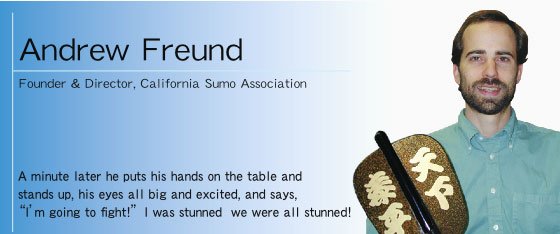
Absolutely! It happened last summer, but I couldn’t tell anyone about it until now. As you know former Yokozuna and Oyakata Akebono was our guest last summer. He was great to be with and bent over backwards to make himself accessible and give autographs to everyone. People were just mobbing him, photograph after photograph, and he was okay with everything. The day before the tournament he even participated in our sumo clinic demonstrating different moves and techniques, but on the final day of the tournament something remarkable happened. For the most part he sat waiting patiently watching the competition. Toward the end though, after we had completed the lightweight, middleweight and heavyweight classes, he started to get more animated. I was sitting next to Akebono and he was dressed in a white shirt and slacks… and all of a sudden he got really excited and into it. A minute later he put his hands on the table and stands up, his eyes were all big and excited, and says, “I’m going to fight!” I was stunned̶ we were all stunned! So we cleared a path for him and within five minutes he had changed out of his clothes and had put on a “mawashii” and started warming-up. He started doing his “shiko” and getting psyched up. And then he says, “I need a practice match.” So we grabbed some of the guys who weren’t fighting and Akebono proceeded to play with them and toss them around. He was waiting to fight the open weight champion ̶Barnabas Toth from Hungary. Now Barnabas is no pushover, he trains all year and has beaten many of the Japanese pros, but when they fought it was amazing how easily he handled him. All of us were thrilled and Akebono was such a gracious competitor, he wrestled a few more times to give everyone a chance. It’s really astounding for any active “rikishi” to compete against amateurs let alone a former Yokozuna or Oyakata! We couldn’t talk about it back then, but now we can since Akebono has officially retired as an Oyakata and apparently will be fighting in K1, professional kick-boxing. If the past tournament was any indication he’s still in great shape and a world-class athlete. —— What does the CSA do when you’re not preparing for the U.S. Sumo Open? —— For example, if I were just starting off, what would I be doing my first day?
|

