




 |
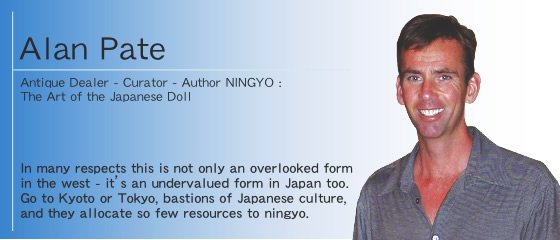
| —— Can you tell me a little about this ningyo exhibition “Ningyo: The Art of the Japanese Doll” that you are guest-curator of here at the Mingei International Museum in Balboa Park? This particular grouping comes from 7 different lenders across the US and I would say this is the best, most comprehensive, display ever attempted outside of Japan. I would push the point further saying, that, in terms of breadth, it would push anything that’s ever been done in Japan as well. It focuses on six categories of ningyo: gosho-ningyo (palace dolls), hina-ningyo (Girl’s Day dolls), musha-ningyo (Boy’s Day dolls), isho-ningyo (dolls of fashion and popular culture), karakuri-ningyo (theater dolls, some of which are mechanical) and dolls relating to health. I’m not saying that there aren’t better examples in Japan, but in terms of breadth, this would give most any Japanese exhibition a run for its money. Every country in the world has a doll culture, every one; it’s just instinctual. Ningyo by origin can be traced back to prehistory of Japan. Basically, in 3000 or 4000 BC, the Jomon period, they were using clay figurines for fertility rights. And you can trace, from that moment on, historically, archeologically and culturally that ningyo have played an essential role in any number of cultural rights and practices, including their richly textured layered ceremonies and have been infused into the Japanese psyche to a degree. Consequently, ningyo resonate with Japanese on a far deeper level and so the way they view them is different. Antique ningyo that have passed through people’s hands and passed through their families, even today in contemporary Japan and with the most educated person, they are still going to feel that there is a residue, a lingering essence from these other families that they don’t want to bring into their home. It is that very reason it is possible to put together a collection of this magnitude outside of Japan, as opposed to some other art forms that are far more difficult to pry away. —— So would you say that our concept of the word doll doesn’t encompass the depth that ningyo does? Oh, very easily you can say that. The word doll, while it is the translation, is not true to the spirit; it’s not true to the essence; it’s not true to the expansiveness of the term ningyo in Japanese. We don’t have a term that truly describes it and doll falls far short. It doesn’t exist in English because a doll is a plaything; a doll is something lesser. It’s a doll with a small “d” as opposed to something with more weight, something legitimate. One of the thing first things we need to do is explain that these by and large were not made for children; the vast majority of what you see weren’t meant to be handled by children-they were display dolls or they were used for very specific functions that fell very much into an adult purview. —— You mentioned that as long as we can remember this art form has been around, when did the art form take the shape that we see here at the exhibit? The Edo period. It’s totally an Edo art form when there was a confluence of peace, stability, and rapidly rising fortunes. Society was awash with money and they could focus on things like ningyo to elevate them to forms that they never achieved before. If you go back to the Muramachi period and the Momoyama period you’ll see paintings of noblemen or noble children with their ningyo, but in comparison they are very rudimentary. During the Edo period, very quickly, these rudimental figures began to evolve in to something totally other and I think to my mind they reached their apex during the Edo period. They’ve been in decline ever since in terms of the value system that I place on them. It has to do with cultural resonance issues, which I guess a contemporary ningyo artist would be very offended by that comment. While modern craftsmen are bringing in a great deal of artistry and care, and I respect that and honor that, but I think that there is a disconnect between what they are doing and what was once done. I think once you started introducing western technology, the aniline dyes and manufacturing processes, there was a shift and it’s different. The antique dolls reflect on a different era, from style to equipment and materials. They have aged, mellowed and reacted to time and that gives them a quality that I truly appreciate. It gives them a subtle yet unduplicable character. —— Speaking of materials, what are ningyo generally made from? 
Ningyo with mechanical features, such as this gosho-ningyo, have moving arms that allow raising its mask. Photo by Lynton Gardiner
Finally, there is the gofun, or pulverized oyster shell and animal glue composite, which was applied on the surface and gives the ningyo their opalescent porcelain sheen. Gofun, although introduced from China and further west along the silk-road, we suspect originated in Persia. It was applied by brush on the base material and then burnished layer upon layer, quite similar to a lacquer technology. The animal glue composite gave it a certain plasticity, so it was also used for minor molding. Some of the faces are not fully wood sculpted, rather articulated with the gofun itself. It really creates something otherworldly and it is the most distinctive characteristic of the Japanese dolls-that shining white face. Gofun, however, is both the boon and bane of ningyo in that it creates a transcendent beauty, but it is also so fragile. You apply it over a wood core, but the wood itself is expansive and contractive, while the gofun is not. Under the right conditions gofun can last perfectly for hundreds and hundreds of years, but give it too much heat or humidity and the wood will expand or contract and then you’ll get cracking-and if you apply water you will actually wipe the gofun away! A well known collector remembers when she was quite young and her father, also a ningyo collector, had brought home a gosho-ningyo that the family was just gaga over. It was absolutely amazing and worth roughly the equivalent of their home. Well, her younger brother saw that the family was very excited about all of this, but also saw that the doll was not quite clean; it was slightly soiled. So he decided to help out and clean it-by taking it into the ofuro with him! There he carefully and lovingly cleaned it and later proudly presented the now clean and gofun-less ningyo to the family. It is an intuitive thing for most people to want to clean them by wetting their finger or taking a moist rag to shine them right up. Well that will eat right through the gofun like nobody’s business! You just can’t treat it like porcelain; you can’t treat as anything but what it is. —— So Alan, what about your own personal interest in ningyo, how did it start and then turn into this quest? 
Some ningyo transcend their wood, silk and gofun. If you listen closely̶you can almost hear this isho-ningyo laughing. Photo by Lynton Gardiner.
—— Was it difficult to pierce the veil of myth surrounding ningyo? —— So the dolls themselves reflect on the culture in a way that couldn’t be voiced in other ways? —— I understand that you have one of the “friendship dolls” here, what is the story behind them? 
This“Friendship Doll”, from 1927, was one of only 58 ever created as gifts from Japan to each of the 50 states and select museums. Photo by Lynton Gardiner.
—— So even such meaningful examples continue to be under appreciated. What is your hope for us and for ningyo? 
Alan, alongside the exquisite bunraku-ningyo. Ningyo such as this were puppets, with moveable heads, hands, eyes and eyebrows
I don’t think it will ever become a household word, but particularly on the institutional level, I would like to see each and every museum that has an Asian Art collection have respectable examples that they display periodically. Most museums don’t even have a ningyo collection and these are places that ought to know better. They should be more aware and have a greater respect for the form and a courage and understanding to introduce it to their public-that’s the mandate of a museum. The ultimate purpose of a museum is to educate and from education comes appreciation. Understanding breeds appreciation. I have a very strong belief that we are only temporary custodians of these marvelous pieces. They’ve already survived 300 years and I know that I can’t keep them long personally; I’m only holding them for a moment in what I hope will be a very long lifetime.
(08-01-2005 issue, Interviewed by Terry Nicholas) |