




 |
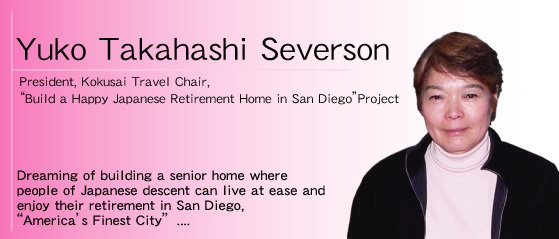
| According to a survey on life after retirement, conducted by an insurance company, people are most worried about “becoming ill, bedridden, or senile,” followed by “having financial difficulty” and “living alone and being lonely.” Meanwhile, it is said that Japanese people living in retirement homes in the US have unique problems — language and food. We interviewed Ms. Yuko Takahashi Severson, chair of the“ Build a Happy Japanese Retirement Home in San Diego” Project. She told us how she started the project with the motto“ Support Seniors’ Comfortable Living and Peace of Mind.” —— What made you start the project? Currently, there are some Japanese retirement homes in Los Angeles, San Francisco, Seattle, and other cities. Unfortunately, the one in San Diego has an income-level requirement to determine the eligibility of residents. While our society is aging, more and more Japanese seniors in “America’s Finest City” wish to find Japanese retirement home operated by a nonprofit organization. Quite a few Japanese seniors have moved out of Americanoperated retirement facilities because of their food preferences or communication problems. Although many foreigners in the US have chosen to live outside their own countries, they miss the language and customs of their countries as they grow older. Japanese come to miss the Japanese language and food. Imagine if there were a “home for the last stage of life” in San Diego, where you shared the same culture and customs as the other residents 20 to 30 years after retirement — the most joyous, precious time in life. Don’t you think it is encouraging? Having more choices in life means having a brighter future full of hope. —— Can you tell us about the history of housing complexes for senior citizens in the US? In the 20 years following the 1960s, many private nursing homes were built in the US. Most of them were facilities for so-called “granny dumping.” We saw a rapid decline in such facilities as the federal government revised its licensing system for nursing facilities in 1987. Then came the “assisted living homes” operated by nonprofit organizations and good companies. —— Can you tell us about Japanese retirement homes in the US? Keiro Senior HealthCare in Los Angeles, which was founded in 1961, is the largest Japanese nonprofit organization in the US. It was founded by Mr. Fred Isamu Wada, a produce dealer and a leader of the LA Japanese community. Seeing that Japanese seniors were having problems with language and food in American facilities, Mr. Wada decided to found the organization, aiming to build a facilit y where Japanese seniors could live comfortably. Keiro Senior HealthCare has four separate facilities: a retirement home, an intermediate care facility, and two nursing home buildings. It also provides daycare programs for adults. In Seattle, Washington, a nonprofit organization called Nikkei Concerns was founded in 1975 and has been the leader in promoting comprehensive support for Japanese seniors in the area. The organization was started by seven Nisei (second generation of Japanese Americans), who were concerned about the Issei (first generation) as they were growing old. The organization provides culturally-sensitive comprehensive care and operates various facilities, including “Midori Condominiums” for senior citizens, “Nikkei Manor,” an assisted-living apartment complex for senior citizens, “Seattle Keiro,” a nursing home, “Kokoro Kai,” an adult day program, “Keiro Daycare,” a rest center, and “Nikkei Horizons,” a continuing education facility for active seniors.—— Can you talk about your parents? 
Celebrating her father’s (Mr. Kihachiro Takahashi) reception of the Order of the Sacred Treasure with her mother Shizue,1983.
My father, who was born in 1913, opened a photo studio in Yokosuka, Kanagawa in 1941, the year the Pacific War broke out. Before the war, there was a Chinjufu (a superior command in charge of the defense of naval ports) in Yokosuka. So my father took a lot of commemorative pictures of the soldiers. When my father was a teenager, he got hit by a pitch in a baseball game and developed osteoarticular tuberculosis. As a result, his legs were paralyzed for the rest of his life. Because of his immobility, he read various genres of books in bed. Also, his parents encouraged him to study photography, because they wanted him to learn a trade. Because of his disability, he didn’t have to go to war. Instead, he devoted his life to the social welfare of people with disabilities as a politician after the war. He first served as a city council member for the Socialist Party and later as a prefectural assembly member from the Democratic Socialist Party for eight terms, for 32 years. Like my back problem, an event can play as a trigger, changing your life drastically in a positive way. I’ve read somewhere that a change involves a cycle of “start,” “emptiness,” “recovery,” and “security.” A person experiences a turning point in one of these stages. Come to think of it, I think that I’m experiencing a turning point of my life right now. 
With Joe DiMaggio at the World Children’s Baseball Fair, held in San Diego, July 1993.

At Mauna Kea Volcano in Hawaii, celebrating her 60th birthday, January 19,2005.
FYI: Our group will be holding the first meeting at 2:00 p.m. on June 10, 2006, at Kokusai Travel (2815 4th Avenue, San Diego, CA 92103). Everyone is welcome.
|