




 |
|
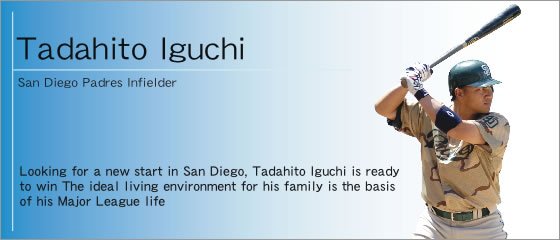
In Iguchi’s first year in Major League Baseball, his team, the Chicago White Sox, won their first World Series in 88 years. Last year, the Philadelphia Phillies, which he joined in the second half of the season, did extremely well and came from behind to win, making the playoffs. He has always been in the spotlight as a baseball player. Wherever he goes, a miracle happens. This year, the San Diego Padres welcomed this talented infielder with extraordinary luck. His first home run as a Padre led the team to win in an extra-inning game, making a strong impression on the fans in San Diego. He is the only one Padre player who have had the experience of winning a World Series. His teammates and fans are excited about “Gooch”, the powerful leader, with their hearts full of hope and expectations. —— You received offers from several teams. Can you tell us why you chose the Padres? 
Iguchi, in Padres uniform, upon joining the team (PETCO Park, Dec. 18, 2007) © kyodo
Living with my family in a good environment was my first priority. A safe city where we can spend time together comfortably during my off-season was the main criterion for the choice. In San Diego, I can also train during off-seasons. The city has a low crime rate, so I thought it would be the best place for us as a family to live. We used to live in Chicago and I liked it there, but it was just too cold in winter…. (Laughter) —— Now that you’re in San Diego. What’s your impression of the city? —— What’s your image of the Padres? —— You’ve signed a one-year deal with the Padres, right? —— What’s your goal for this season? Every year, before the season starts, I set a personal goal of hitting .300, stealing 30 bases, and scoring 100 runs. The Padres need to score more runs, so my number one goal is to hit and score 100 runs. I believe that’s my job. —— When did you become interested in baseball? Did you like baseball when you were a child? —— When did you start dreaming about playing in the Major Leagues? 
In his first MLB year, his team, the Chicago White Sox, won the World Series. Iguchi presents then Prime Minister Koizumi with a White Sox uniform and cap (Prime Minister’s Office, Nov. 14, 2005)
© kyodo When I was a freshman in college, I played in the Japan-U.S. College Baseball Series, and the American players left a strong impression on me. I also played against the Latin American teams in the Atlanta Olympic Games in 1996, so I wanted to play with these players again. After joining the ranks of Japanese professional baseball, I still wanted to play on a global stage. Perhaps, I started vaguely dreaming about playing in the Major Leagues when I was in college. —— Who was the Major League player you idolized? —— What was the biggest turning point in your life? When did it come? It came in my third or forth year with the Daiei Hawks. In 1999 or 2000, perhaps. I wasn’t performing well then and I was thinking, “How can I survive as a pro?” I was looking for an answer. One of the ways I tried was by changing my registered name as a player—I changed the kanji for “tada.” I just followed the advice of a name fortune teller, but I believe it was at the very least effective in resetting my mind. Then in 2001, I was able to overcome the biggest crisis of my baseball career, with satisfying results. (*2) —— What’s the difference between Japanese baseball and Major League baseball? —— Did you learn anything new as a Major Leaguer? —— Have you experienced any difficulties living in the U.S.? Professionally, I don’t have any problems, but in daily life, I always have some difficulties. (Laughter) For example, I sometimes can’t make myself understood in English when I go shopping with my family. Or, I order something in a restaurant and get something else…. That happens so often. (Laughter) —— What’s your preference in the batting order of the Padres?

Iguchi’s first home run as a Padre was a walk-off homer! Everyone on the team congratulates him (bottom of the13th inning of the game against the Arizona Diamondbacks at PETCO Park, Apr. 26, 2008) © Chris Hardy / San Diego Padres
I’ve been a second batter for four years since I joined the Major Leagues. I believe it’s ideal for me. So I’ve come to understand the responsibilities of batting second…whether there is a sign or not, I know what to do according to how the game is unfolding. For example, when to hit a sacrifice bunt to allow the base runner to advance. Early on, I didn’t always want to play the role of a second batter because I’d often have to hit a sacrifice bunt or fly. But, I’ve overcome it. —— It seems difficult for the players to hit home runs at PETCO Park, the home of the Padres. What’s your impression of PETCO? PETCO Park is definitely huge. I hardly hit a home run even during batting practice. (Laughter) But I believe I can contribute to the team more by hitting doubles or triples rather than home runs. I think PETCO Park is ideal for running. It’s also a clean park and I don’t think it’s difficult to get hits there. —— Can you send a message to the fans who hope the Padres will win the league championship? —— You’re also active in charities, such as visiting and cheering up patients waiting for heart transplants. 
Iguchi visits and cheers up Takuya Matsumoto (right) who is hospitalized for a heart transplant (Chicago, Apr. 6, 2007) © kyodo
Although, I’ve always been supported by so many people, I personally wasn’t able to do anything to give back in return. So I started visiting kids at children’s facilities and children’s wards in hospitals as a way of showing my gratitude. They were glad to see me and I was very moved by that and they motivated me to work even harder. There are children who come to America – an unfamiliar environment to them – to wait for their operations. They don’t know how long they’ll have to wait. I like visiting them and talking with them so that we as Japanese on foreign soil can cheer up each other. I’d be glad if I could make them happy by doing so. I’d like to continue these activities whenever possible. (*3) —— Can you tell us about your dream for the future? *1: Cal Ripken, Jr.: Former Baltimore Orioles infielder who entered the National Baseball Hall of Fame in 2007. He holds the Major League record of 2,632 consecutive games played. He retired in 2001. *2: In 2001, Iguchi became the third player in Japanese professional baseball history to hit 30 home runs and steal 40 bases in the same season. *3: February 2008, Iguchi visiting and cheering up patients at the University of Tokyo Hospital waiting for heart transplants. April 2007, as a White Sox player, visiting the University of Chicago Medical Center to see Takuya Matsumoto (pictured on page 14) from Kumagaya, Saitama who was waiting for a heart transplant. Iguchi donated a million yen to the fund set up to cover Takuya’s medical expenses. His operation was successful and he is well, living in Japan now. Since Iguchi was with the Daiei Hawks (currently the Softbank Hawks), he’s been active in charity, donating wheelchairs and automated external defibrillators, as well as making contributions to guide dog training. |
| (06-16-2008 issue) |