



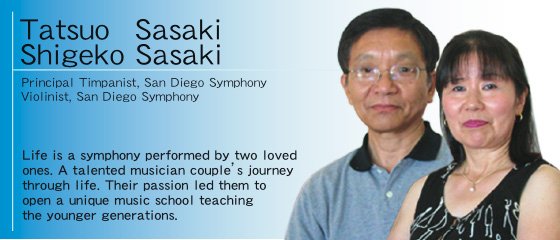


| —— Can you tell us what you’ve been doing lately? 
At the Athens Festival in Greece, August 5, 1969.
Shigeko In addition to playing symphonies and operas, we perform with the San Diego Chamber Orchestra, make recordings, and play chamber music. Although we are extremely busy, we’ve never skipped practice; practice is important for us to maintain our skills and technique. 
Tatsuo playing the marimba at a“Piano Opening”ceremony in elementary school, 1957.
Tatsuo It all started by chance. When I was in first grade, I was assigned to play the xylophone for a talent show at school. My classroom teacher, a music teacher, realized I had a talent for music when she heard me play. When my father learned of this, he was very enthusiastic. He went out to buy lumber and made a xylophone for me. In those days, there were only two xylophone players in Japan, Yoichi Hiraoka and Eiichi Asabuki, and they were popular throughout the country. We enjoyed listening to their performances on the radio every morning. Mr. Hiraoka later became my xylophone mentor. I’d listen to their music every morning while I practiced on my own. Shigeko My mother was very open-minded for a Japanese woman born and raised in the Meiji Era. She learned English and piano from British missionaries on a special program at a mission school. Later, she became a Christian and an organist for her church. My mother loved playing the piano and wanted me to learn it as well. But, it was right after the war. We couldn’t afford to buy a piano. Instead, Mother bought me an organ. That determined the course of my life. —— How and why did you go to music college? 
Shigeko studying violin at her mother’s encouragement, 1953.
Shigeko I was born a month before the end of the war. I was the youngest of six siblings in my family. The food situation in Japan was terrible at that time. My father, a graduate of Kyushu University, Faculty of Agriculture, had started dairy husbandry. He was determined to save children in Japan who were suffering from hunger. So he had quit his office job and went to the countryside, and started cultivating land there. He was rather academic, so he considered music as entertainment. At first, he didn’t accept my mother’s wish to let me to study piano. Yet, her enthusiasm finally persuaded him to allow me to study piano. First, I went to a senior high school in Osaka, aiming to pursue a music career, but later, I transferred to a girls’ school in Tokyo at my mother’s request. In those days, it was common for students wishing to enter music colleges in Tokyo to travel to the city for music lessons. After graduating high school, I went to the Kunitachi Conservatoire. It was my mother’s strong will that made me a musician. I’d say. —— How and why did you join the San Diego Symphony? Shigeko After graduating from the Kunitachi Conservatoire, I performed in a Yomiuri new talent showcase concert in Tokyo. Afterwards, I joined the Japan Philharmonic Orchestra for which Mr. Seiji Ozawa was the principal conductor. Then I got married and moved to Brazil. We’ve always made important decisions at the last minute…our marriage, moving to Brazil, and coming to San Diego, etc. In September 1973, we moved from Brazil to San Diego, with our new-born son. 
At the Recital Hall of the Tokyo Bunka Kaikan, 1970.

At a performance of the San Diego Symphony, 1995.
Shigeko I’d say one of my achievements is that I graduated from my university as its top student. Another thing is that I’ve been performing with three international orchestras for a total of 37 years. Our son was born in Brazil and our daughter in San Diego. Both are now medical doctors. I’ve accomplished my role as a mother and I feel relieved. I am proud that I’ve managed both family life and work in a foreign land. I call it my ultimate achievement. —— What do you do to hone your skills? Shigeko Playing the violin requires an unnatural posture, which isn’t good for the body. While continuing to play for many hours every day, I’ve been having problems with my shoulders, neck and back. So I started doing Qigong (a Chinese exercise system) after a friend of mine recommended it. Since learning how to relax my body, I’ve felt better. Managing one’s own health is the first priority, I’d say. 
At a performance of the San Diego Symphony, 1975.
Shigeko My idea of bliss is being in nature. I feel happiest when I am blending in with the trees, flowers, and plants. Painful moment? As a musician, it’s important for me to maintain myself in the best mental and physical condition for upcoming performances. So I must always be vigilant. This requires exceptional patience. Paradoxically, I have been consoled by the power of music whenever I encounter difficulties in my daily life. In the evening, we dress in black and jump into a different world. When we are done with work, we return to the real world. I think living such a two-dimensional life has rescued us from the earthy reality of life. —— Can you tell us about the benefits of music? Shigeko If children have been exposed to classical music since early childhood, they’ll develop a strong power of expression and a good sense of sound, which will allow them to hone their sensitivity. Accordingly, they’ll improve their imagination, expanding their unique worlds. Also, if children have managed to learn to play an instrument on their own, they’ll become generally patient. In the same way as learning a language, the earlier a child is exposed to music, the faster he or she acquires musical skills. For example, children learn with ease the difficult and complicated skills required in playing the violin, which are physically and mentally demanding. Even if they stop taking lessons four or five years after they started their lessons, they will never lose their sensitivity that they have acquired through music. —— Can you tell us about the Sasaki School of Music? 
At the wedding ceremony for daughter Maki, March 2005. From left to right: Shigeko, Tatsuo, Maki, Toshiyuki Minami (bride), Jun (son of Mr. & Mrs. Sasaki), Mui (Jun’s wife), Benjamin (son of Jun and Mui), March 2005.
Shigeko Until recently, I’d thought I would do something other than music when I retired. I was interested in living a totally different life because I’d devoted my life to the violin. But, I realized that playing the violin had become a part of me. When I began considering retiring in the near future, I suddenly started having this sense of mission, “We must pass on to the younger generations what we’ve learned!” I strongly believe it is necessary to do so especially because today’s young people are less interested in classical music. A basic knowledge of classical music is useful for children even if they become interested in jazz or rock music later in their lives. I’d like to see success in our students with whom we have shared the joy of music. It would be my ultimate pleasure to see some of them become professional musicians, regardless the field.
|