



 |
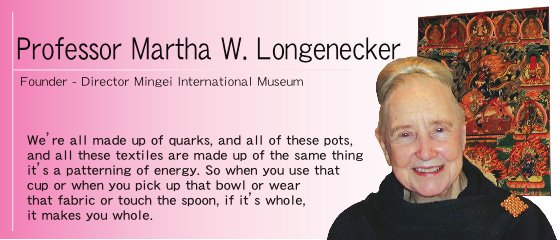
| —— Can you tell me a little bit about the Mingei International Museum in Balboa Park. Well the museum that you see today in Balboa Park opened on August 8, 1996, as the permanent home of the Mingei International Museum, but the seeds of it’s existence were sown by decades of events and experiences all around the world. Over the years I’ve visited and studied in Japan again and again, bringing artists and students to and from, and overtime it became clear that some type of organization was needed to facilitate these cultural exchanges. So with the help of my late husband in 1974, I decided to incorporate Mingei International as a non-profit, public foundation dedicated to furthering the understanding of “arts of the people”(mingei) from all cultures of the world. A few short years later, in ‘77 we were presented with a wonderful opportunity to create a museum inside the University Towne Centre that Ernst Hahn had been developing. Personally, I felt a responsibility to help continue and contribute something to the work which Dr. Soetsu Yanagi, who, along with the revered potters Shoji Hamada and Kanjiro Kawai, founded the Mingei Association and established the Tokyo Mingeikan in 1936. At that time, the last thing I needed to look after was a museum ̶ my life was full. I was a full-time Professor, had a husband, a family, but it was the chance of a lifetime ̶ so I took it. And then it didn’t just fold up, it kept growing and growing, to the point were we currently possess a magnificent collection of more than 12,500 examples of “mingei” from over 100 different cultures. In addition to this, our collection is supplemented by a marvelous educational program, including numerous books, videos and illustrated lectures distributed throughout the world, and we’re not done yet. Hopefully by the end of October our satellite museum in Escondido will be nearing completion. —— What is the essence of mingei? Simply put it’s the creation of things that are made whole, that are expressive of the whole being ̶ that are a total action of an unfragmented human being. The expression of which is what we have come to know as “mingei”. The word mingei was coined by Dr. Yanagi, because he said there were no words in English or Japanese to adequately express what they were talking about ̶ this object that was a result of a total action of a non-fragmented individual, even though there were many examples of that in pre-industrial times there was no word to describe it. Folk art didn’t describe it and so he coined the word mingei, “min” 民 meaning “all people” and “gei” 芸 meaning “art”. It takes some time to really understand the depth of that and it’s really tied in with a whole way of living, a philosophy ̶you might say a whole spiritual orientation. —— A lot of people seem to equate folk art and mingei, are they the same? People often and incorrectly use them interchangeably. They are not the same ̶ not at all! Folk art is an English term, it’s a phrase that is interpreted in so many ways… countless ways. Some people interpret folk art in a limited sense as a work of untutored craftsmen, perhaps from primitive people. In the very broad sense you could say folk art is art of all folks. It’s so mixed up and people argue over what it means and we really don’t want to be concerned with all that. We say that in our collection here we do have some folk art. We have things that are very definitely folk art… some early American quilts, weather veins and other things that are truly classified as American folk art. So mingei can include some folk art, but mingei the “art of ALL people”, encompasses so much more. It’s very broad and wonderfully deep. You see even with the word mingei there are so many people who really don’t understand it, because they haven’t taken the time to fully understand the teachings of Dr. Yanagi or Shoji Hamada. Some people still think it’s just the work of pre-industrial Japan or of village people etc. Now those works are marvelous and they’re beautifully collected by us, and of course the Mingeikan in Tokyo, but mingei also includes the works of contemporary artists. It’s not a matter of past or present, it is any point in time when there’s an unfragmented expression. —— How were you first introduced to Mingei and Dr. Yanagi?  Following W.W.II Dr. Yanagi and Shoji Hamada, along with Bernard Leach, went on a world tour giving seminars to talk to young craftsmen to encourage them and tell them how important it was to continue to make and use objects that were whole, that expressed the body, mind, and spirit. Well in December of 1952, while I was still a university student and thanks to a Christmas gift from my mother, I was able to attend their seminar in Los Angeles. I was totally absorbed by it ̶ it transformed my life. They saw that and wanted me to immediately come to Japan and study, but at that time I just couldn’t. I had a husband and child and work. It wouldn’t be until 10 years later that I was able to go on a sabbatical leave from San Diego State University and finally study with them in Japan. Following W.W.II Dr. Yanagi and Shoji Hamada, along with Bernard Leach, went on a world tour giving seminars to talk to young craftsmen to encourage them and tell them how important it was to continue to make and use objects that were whole, that expressed the body, mind, and spirit. Well in December of 1952, while I was still a university student and thanks to a Christmas gift from my mother, I was able to attend their seminar in Los Angeles. I was totally absorbed by it ̶ it transformed my life. They saw that and wanted me to immediately come to Japan and study, but at that time I just couldn’t. I had a husband and child and work. It wouldn’t be until 10 years later that I was able to go on a sabbatical leave from San Diego State University and finally study with them in Japan. —— What were your impressions of your trip to Japan? —— Seems like it’s never ending. —— When I look at these works I’m drawn to them, they give off a vibration that makes you want to hold them and get closer. —— How are we, or are we, developing individuals that can create the next era of mingei? We believe it’s done by people having the opportunity to see and experience mingei. Just as in music they have to have the opportunity of hearing great music, in food they have to have the opportunity to taste the real food… and that’s really why we have our museum, to provide the opportunity for people to see the finest quality of real mingei, art of the people, from every culture. Dr. Yanagi himself said that you have to have an empty mind to just see. So we encourage teachers when they bring their students here, to quietly look on and encourage students to develop their own insights. —— I once had a professor who said, “Out of the hundreds of people I teach every year I live for the one or two that get it.” Do you find that to be true here? It’s the truth. (laughing) It is exactly the same. Not all are going to see, because not all have the readiness or the emptiness, but when someone does it’s so rewarding. That’s why when masses of people come through, not only on “free Tuesdays”, but during “Christmas on the Prado”, when 4,500 people an evening come through, and they are so reverent and they so love it and their children are watching and looking. That means everything to me. I remember one particular little boy who got it. He was screaming, “Come here! Come here!” and his friends came running over to the Indonesian basket where the outer coating of the bamboo had been taken and wrapped around the joint, which made a wonderful pattern and made it sturdy, and he saw that and shouted, “Look! Look what they did there!” (smiling) —— As potter you’ve spent most of your life creating, and now you wear so many hats. Do you get the same fulfillment from the business side of things that you did from potting? It’s great fun for me to put on the exhibitions… that’s play. It also a very creative task, putting up an exhibition, it’s like a sculpture and it takes a lot of work, but it’s not the same as having my hands in clay. That feeling is wonderful because you’re centered! Before the museum… the organization, fundraising, balancing the budget, the 81 plus books, videotapes, the invitations etc. I taught pottery, full-time for 25 years, so I had my hands in clay everyday ̶ making pots and teaching. The whole process is a centering process you see. You can’t throw a pot unless you’re centered. And I have not gotten back to making pottery… occasionally I’ve made a piece or two, but pottery isn’t something that you just pick up like painting. You’ve got to get the clay just right, you’ve got to get it all wedged and then after you throw it you’ve got to trim it at just the right time, and you’ve got to dry it, and you’ve got to strain all your glazes and glaze it, and then you need a load to fire the kiln, so you see what I mean. This has been a frustration of mine that I have not gotten back to it yet, but I still feel that I will… I am. (10-01-2003 issue, Interviewed by Terry Nicholas) |

